Article 29 of Decree 217/2026/NĐ-CP sets out what a Vietnam feasibility study report must contain. For a business investment project, it lists only eight groups of mandatory content. It does not specifically require a financial analysis. That part depends on what the investment decision-maker requires.
This article is written from an investor and modeler’s perspective. It is not legal advice. Provisions are cited so you can look them up. For a real project, ask a lawyer about the specific point.
- Decree 217/2026/NĐ-CP takes effect on 1 July 2026 and replaces Decree 175/2024/NĐ-CP.
- A project with total investment of no more than VND 40 billion (excluding compensation, site clearance and land use fee) only needs an economic and technical report.
- For business projects, Article 29 lists 8 mandatory content groups and does not itemise the financial analysis.
This has a practical consequence for anyone building the model. I explain it below, after setting out which text is in force. The English here is my own rendering of the Vietnamese text and is unofficial. The Vietnamese original prevails.
What is Decree 217/2026?
Decree No. 217/2026/NĐ-CP was issued by the Government on 19 June 2026. It details a number of articles of the Construction Law No. 135/2025/QH15 (the Construction Law 2025) on the management of construction activities.
Under Article 75, the decree takes effect on 1 July 2026, and Decree 175/2024/NĐ-CP ceases to be effective from that date. Under Article 76, a project whose feasibility study appraisal result was already notified by the construction specialist agency before the decree took effect does not need to be appraised again. The remaining stages and any project adjustment follow the new decree. Decree 217/2026 was later amended by Decree 347/2026/NĐ-CP of 8 September 2026. Articles 27 and 29 in the consolidated text still read as described in this article.
Which projects need a feasibility study report?
Not every project does. Under Article 27, small or technically simple projects only need an Economic and Technical Report. These include:
- construction projects for religious purposes;
- projects with total investment of no more than VND 40 billion, excluding compensation, site clearance and land use fees;
- maintenance repair projects of group C scale;
- dredging projects for public maritime channels and inland waterways;
- projects mainly about procuring goods, providing services or installing equipment, with construction cost under 10% of total investment and no more than VND 20 billion (with exceptions such as nationally important, group A and PPP projects).
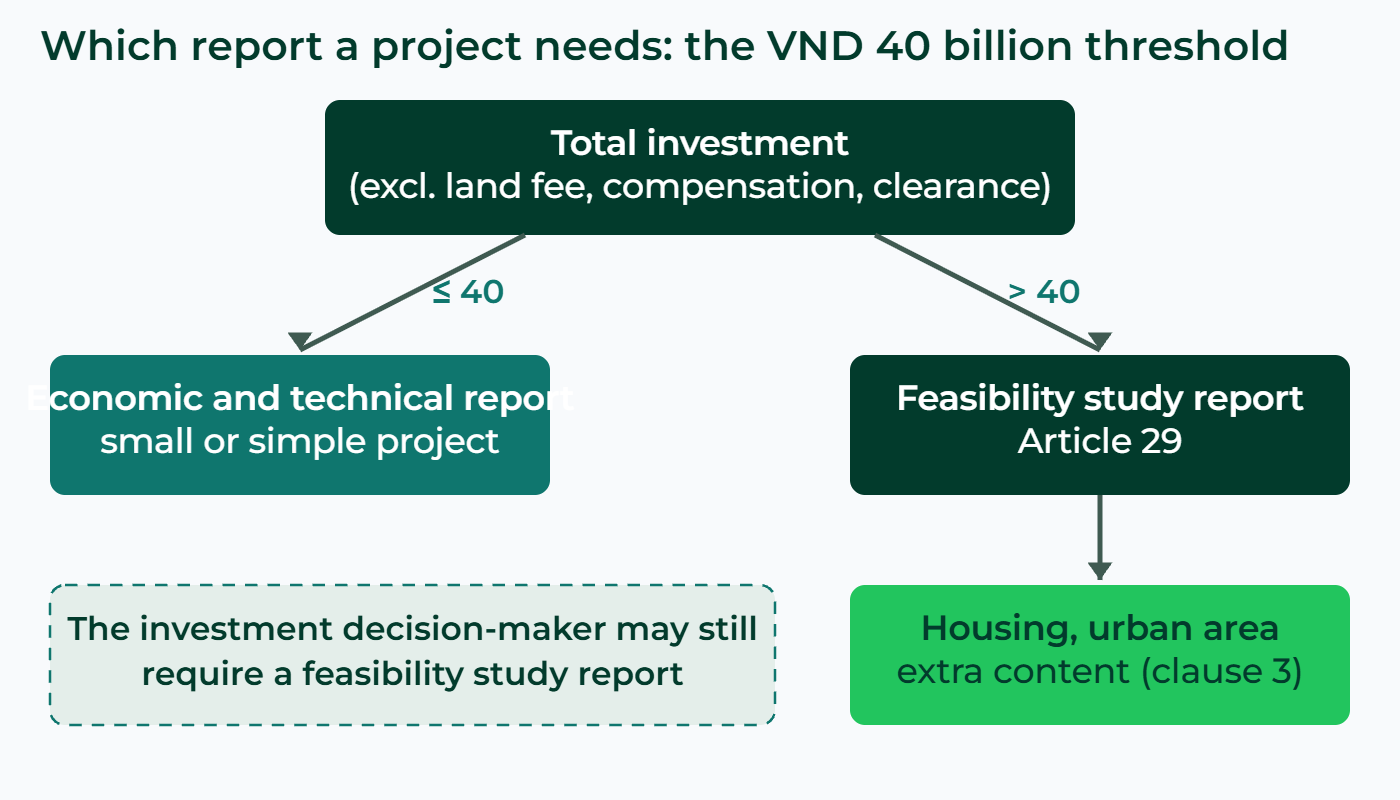
For these projects, the investment decision-maker may still decide to prepare a feasibility study report where management or technology design requires it.
One detail is easy to miss: the VND 40 billion threshold excludes land use fees. A small project with a large land fee can still fall under the Economic and Technical Report route, if the rest does not exceed the threshold.
What a Vietnam feasibility study report contains for a business project
Article 29 is organised by project type. Clause 1 lists the explanatory contents for public investment projects. Clause 2 deals with business investment projects: the explanatory section must show the contents in points a, b, c, d, đ, e, g and p of clause 1, and any contents required by the investment decision-maker.
Put together, the eight mandatory groups for a business project are:
| Point | Content (summarised) |
|---|---|
| a | Necessity, construction investment objectives, scale and capacity. Assessment of conformity with the investment policy or the project information approval document (if any) |
| b | Construction site, land area and land use function. Assessment of conformity with the planning used as the basis for the project and related planning |
| c | Analysis of factors ensuring delivery: natural, economic and technical conditions, resources, labour, technology and equipment, and management arrangements for implementation, operation and use |
| d | Plan for dividing into component projects, independent component projects and investment phases (if any) |
| đ | Environmental impact assessment and protection (if a separate report is required under environmental law, the explanation only states the outcome) |
| e | Overall compensation, support and resettlement plan (if any) |
| g | Expected implementation time and key milestones required by the investment policy (if any) |
| p | Urban projects must address green growth urban development. Urban infrastructure, urban area and urban housing projects must also address climate change adaptation under urban management and development law |
For housing and urban area projects, clause 3 adds further items that must be explained: conformity of the number and area of housing types with the housing development programme and land use planning; the plan to build and complete technical infrastructure before housing is operated, plus social infrastructure and other works; and the plan and list of public-utility areas or works that the investor must hand to the State for management, operation and use (or manage itself after completing construction), with the responsibilities of the investor and the parties involved. Construction and handover schedules must be consistent with the investment policy, if there is one.
Clauses 4 to 8 handle special cases: reports prepared per component project or per phase, technical infrastructure projects, projects using technology with restricted transfer or with a risk of harming the environment (which need a technology explanation), PPP projects (governed by the law on public-private partnership investment), and the construction design content (per Article 20, 21 or 22 depending on the design step chosen).
Where is the financial analysis?
This is the most important point in the article, and the easiest to overlook.
Clause 1 of Article 29 includes points on total investment (point h), funding sources, capital recovery, financial analysis and risk (point i), and socio-economic efficiency (point k). But clause 2, which applies to business projects, does not refer to these three points. It refers only to a, b, c, d, đ, e, g and p.
In other words, on the wording of Article 29, a detailed financial analysis is not on the mandatory list for a business project. It falls under “contents required by the investment decision-maker”.
That does not make the financial section optional. The decision-maker, lenders and investment partners will almost certainly ask for it, in exactly the space the regulation leaves to them. It also means the level of detail in the model depends on the reader, not on a fixed form. I covered this in Real Estate Feasibility Study: differing model formats are normal, and what matters is understanding each line and what the decision-maker needs to see.
How to build the financial section
Even though the regulation does not itemise it, a financial section that survives a demanding reader needs four things.
Assumptions with a basis. Sale price, sales pace, construction cost and cost of capital each need an answer to “where does this number come from?”. Point g of Article 29 requires the report to state implementation time and key milestones, so the schedule in the model must match it.
A real downside case. Slower sales, later delivery and higher cost together, not only a small price cut.
The biggest risk named as a specific line in the analysis.
A model that can be traced. Assumptions in one place, cash flows separated, outputs linked to their sources. See Real Estate Financial Model Structure.
Using a sample report
A sample shows which sections a report usually has. You should not copy one. Article 29 shows that mandatory content depends on project type (public investment, business, housing, urban area), and the financial section depends on the reader. Another project’s template may have too much or too little for yours.
An example: which report does your project need?
Three hypothetical projects, in VND billions.
| Project | Total investment (excluding compensation, site clearance, land use fee) | Land use fee | Report needed |
|---|---|---|---|
| A | 35 | 60 | Economic and technical report, since it does not exceed 40 |
| B | 45 | 20 | Feasibility study report, since it exceeds 40 |
| C (housing) | 200 | 150 | Feasibility study report, with the housing-specific content in clause 3 of Article 29 |
Project A shows the detail that is easy to miss: a large land fee does not push the project over the threshold. For project A, the investment decision-maker may still decide to prepare a feasibility study report if management or technology design requires it.
Where a complete report still falls short
Complete does not mean it answers the question. A report with all eight content groups can still fail to tell people whether the project should go ahead.
The financial section is treated as secondary. Because Article 29 does not itemise the financial part for business projects, many reports keep it thin. Demanding readers, from lenders to investors, ask for exactly that part.
Copying a template. Another project’s template can have too much or too little for yours.
A quick check
- Which type is your project: public investment, business investment, housing or urban area?
- Does the report cover all eight mandatory groups for a business project?
- Does the project exceed the VND 40 billion threshold (excluding compensation, site clearance and land use fees) that triggers a full feasibility study report?
- At what level of detail does your investment decision-maker want the financial section?
- Does the model schedule match the milestones stated in the report?
To see where the feasibility study sits in the chain of project approvals, read Vietnam Real Estate Approvals for Foreign Investors.
Frequently asked questions
What must a Vietnam feasibility study report contain for a business project?
Eight mandatory content groups listed in clause 2 of Article 29, plus anything the investment decision-maker requires.
When does Decree 217/2026/NĐ-CP take effect?
On 1 July 2026 (Article 75). Decree 175/2024/NĐ-CP ceases to be effective from that date.
Does a project appraised before 1 July 2026 have to be redone?
Under Article 76, a project whose feasibility study appraisal result was already notified by the construction specialist agency before the decree took effect does not need to be appraised again. The remaining stages and any adjustment follow the new decree.
Is a financial analysis mandatory for a business project under Article 29?
On the wording of clause 2 of Article 29, the mandatory list does not refer to the financial analysis points. They fall under contents required by the investment decision-maker. In practice, readers will almost certainly ask for it.
Can I use a sample feasibility report?
Use it to see which sections a report usually has, not to copy. Mandatory content depends on project type, and the financial section depends on the reader.
Is this legal advice?
No. It is written from an investor and modeler’s perspective. Provisions are cited so you can look them up.
References
- Decree 217/2026/NĐ-CP on the Government document portal
- Consolidated text of Decree 217/2026/NĐ-CP (as amended by Decree 347/2026/NĐ-CP)
Next step
If you need a feasibility model that a decision-maker, lender or partner will take seriously, see how CREFIC builds them on the investment advisory page, or send the project details through the consultation form.
On your latest project, who is the investment decision-maker, and how detailed a financial section do they demand?
Have a deal to test?
Send the basics and we will tell you what a lender or investor would ask next.
Request a consultation