
A real estate investment analyst career in Vietnam has few openings, and most roles ask for at least two years of experience. It is true that there is almost no direct entry for fresh graduates.
It helps to understand why. This is not recruiter advice. It is my own experience and opinion, and it is subjective.
- Few openings, but also less competition.
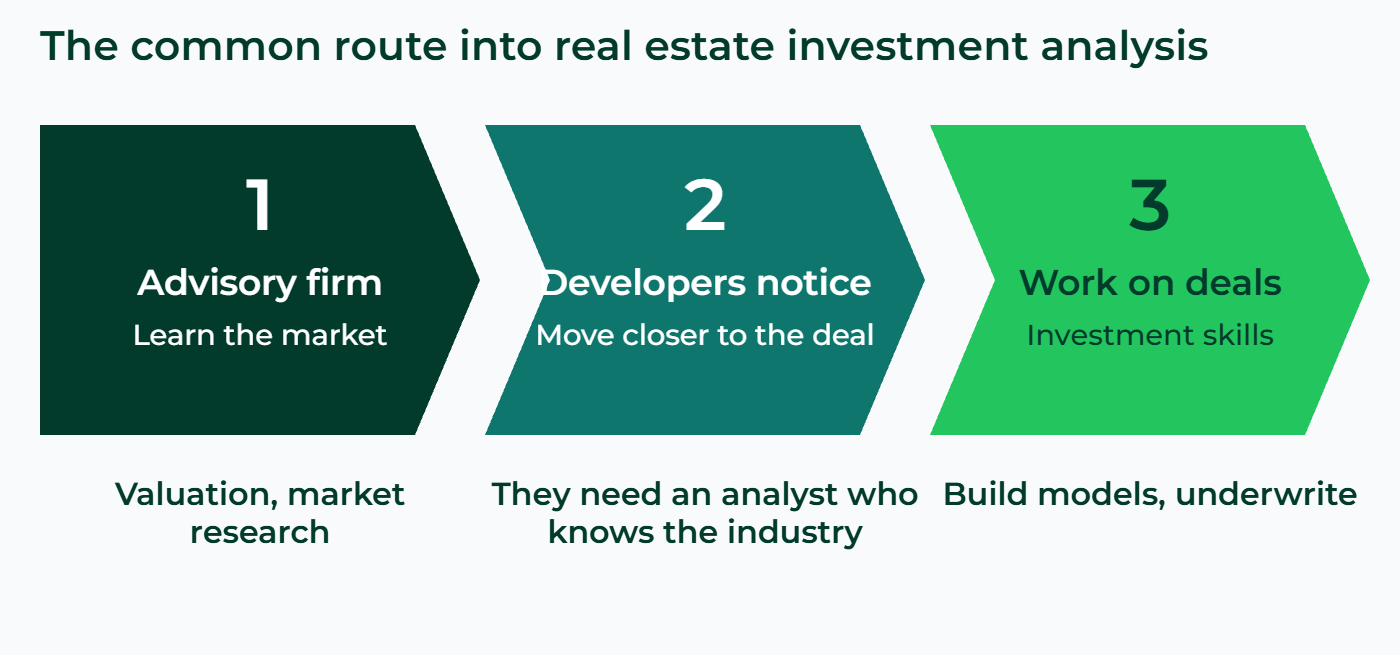
- The common route: an advisory firm in valuation or market research, then developers notice you, then deals.
- Newcomers should understand what an analyst creates in a deal before learning terminology and metrics.
Why there are so few openings
Compared with investment banking, private equity or corporate finance, real estate investment finance is a much narrower niche. Narrower means fewer jobs. It also means less competition, and it is easier to stand out if you think about your career path correctly from the start.
The common route into a real estate investment analyst career
There is a fairly common path, and I took a similar one.
Step 1: start at an advisory firm in valuation or market research, such as Savills, CBRE or JLL. This stage teaches you how the market works before you touch a real deal.
Step 2: developers notice you. They need an analyst who already understands the industry, not someone who learns from scratch.
Step 3: move into deals. This is where you build models, underwrite and work with investors.
None of this removes a basic fact: the field can be hard when the macro cycle turns. But if you build the first two to three years at a real-estate-related firm, the options afterwards improve considerably. Another route worth considering is general finance, then focusing on firms that invest in listed equities or property projects.
If you are starting from zero
Think of a newborn. Nobody learns to talk before learning to roll, crawl and walk.
The first step is not learning terminology or financial ratios. It is understanding what the industry actually does and what value an analyst creates in a deal. Skip that and learning IRR or cap rate is only memorising words, because you do not know why they matter.
Then come the basics:
- Learn the terminology and core concepts of real estate finance.
- Read public reports from Savills, CBRE and JLL to get used to how real market data is presented.
- Take foundation courses abroad, or read specialist books, so you have enough to apply for an internship or junior role.
The order matters. Jumping straight into reports or advanced courses before you see the value of the industry makes it easy to give up, because you cannot see the bigger picture.
What is missing
Vietnam has no real estate equivalent of the CFA. In general finance, a candidate with a CFA has a ready way to show commitment. Real estate has nothing comparable.
That is one reason CREFIC is working on a more complete course for this path, so newcomers have a clearer footing. The course is not out yet. So the honest advice for now is to do what is within your control: learn the foundations, read market reports, and aim for two to three years at a related firm.
The three stages in one table
| Stage | What you do | What you learn |
|---|---|---|
| 1. Advisory firm in valuation or market research (such as Savills, CBRE, JLL) | Data, valuation, market reports | How the market works before you touch a real deal |
| 2. Developers notice you | Move to a role close to the developer | Developers need an analyst who already understands the industry |
| 3. Deals | Build models, underwrite, work with investors | The skill of building and checking models and reading a deal |
In my experience, the first two to three years at a real-estate-related firm are the base that makes later options much better.
Where this path misleads newcomers
Few openings means no chance. Few jobs also means less competition and an easier time standing out if you think correctly about the path.
Jumping straight to an advanced course. If you do not yet see what an analyst creates in a deal, learning IRR or cap rate is only memorising words.
Waiting for a certificate. General finance has the CFA; real estate in Vietnam has no equivalent. That is a gap in the industry, not a reason to wait. Do what is within your control.
Three checks for yourself
- Can you explain what value an analyst creates in a deal?
- Can you read a full public market report and restate three main points?
- Have you built a simple model from scratch, or only filled in someone else’s template?
To see what a complete model looks like, read Real Estate Financial Model Structure. To see what a model should decide, read Real Estate Feasibility Study.
Frequently asked questions
What does a real estate investment analyst career look like in Vietnam?
Few openings, but also less competition. The common route runs through an advisory firm, then developers, then deals.
Can a fresh graduate enter real estate investment analysis?
Very few roles are open directly to fresh graduates, and many ask for at least two years of experience. The common route is through an advisory firm in valuation or market research first.
Where should I start if I begin from zero?
Understand what the industry actually does and what value an analyst creates in a deal. Then learn the terminology, read public reports from Savills, CBRE and JLL, and take foundation courses or read specialist books.
How long does it take to build a base?
In my experience, the first two to three years at a real-estate-related firm. This is a personal opinion, not recruitment data.
Is there a real estate equivalent of the CFA in Vietnam?
Not to my knowledge. That is one reason CREFIC is building a more complete course for this path. The course is not out yet.
Can I go into general finance first and move to real estate later?
It is worth considering: follow general finance but focus on firms that invest in listed equities or property projects.
References
Next step
If you are hiring analysts or need modelling support on a live deal, see how CREFIC works on the investment advisory page or use the consultation form.
Where are you on this path, and what is holding you back from the next step?
Have a deal to test?
Send the basics and we will tell you what a lender or investor would ask next.
Request a consultation