
Exit cap rate is the capitalization rate you assume when you sell the asset at the end of the hold. Sale price equals next-year NOI divided by that number. In most models it is the most sensitive input and the least tested.
Take a simple example. A building has NOI of 12 (VND billions) in the year of sale. An 8% exit cap gives a price of 150. A 9% exit cap gives about 133. Same building, same operations, a gap of 17 from one percentage point in one assumption cell.
- Exit cap rate turns next-year NOI into the sale price.
- In the example, price falls 20% when exit cap rises from 8% to 10%, but equity proceeds fall about 34% because of leverage.
- Always put exit cap in the sensitivity table and run a worse case.
This article uses that building throughout so you can see what exit cap does to sale price, to the cash investors receive, and how to choose it without fooling yourself.
The running example: a hypothetical building
Every number below is an assumption for illustration.
| Item | Value |
|---|---|
| Year-one NOI | 10 |
| Going-in cap rate | 8% |
| Purchase price | 125 |
| Equity | 62.5 (50%) |
| Debt | 62.5, repaid at sale |
| Hold period | 5 years |
| Year-6 NOI (the year after sale) | 12 |
What is a cap rate?
Cap rate is an asset’s annual NOI divided by its value.
The building above has NOI of 10 and a price of 125, so the going-in cap rate is 8%. Cap rate ignores debt. It describes the asset, not the capital structure.
Exit cap vs. going-in cap
The going-in cap rate rests on a real price and real NOI at purchase. The exit cap rate is an assumption about the future: in a few years, what will another buyer pay for this income stream?
Exit value in a model is usually calculated as:
A future buyer prices on the income they are about to receive, so the model uses the NOI of the year after the exit year, which is 12 in the example.
How much does one point change?
Hold NOI at 12 and change the exit cap. The last two columns show the net cash to equity after repaying the 62.5 of debt, ignoring operating cash flow and selling costs to keep the example short.
| Exit cap | Exit value | vs. 8% | Cash to equity | Multiple on equity invested |
|---|---|---|---|---|
| 8.0% | 150.0 | 0% | 87.5 | 1.40x |
| 8.5% | 141.2 | −5.9% | 78.7 | 1.26x |
| 9.0% | 133.3 | −11.1% | 70.8 | 1.13x |
| 9.5% | 126.3 | −15.8% | 63.8 | 1.02x |
| 10.0% | 120.0 | −20.0% | 57.5 | 0.92x |
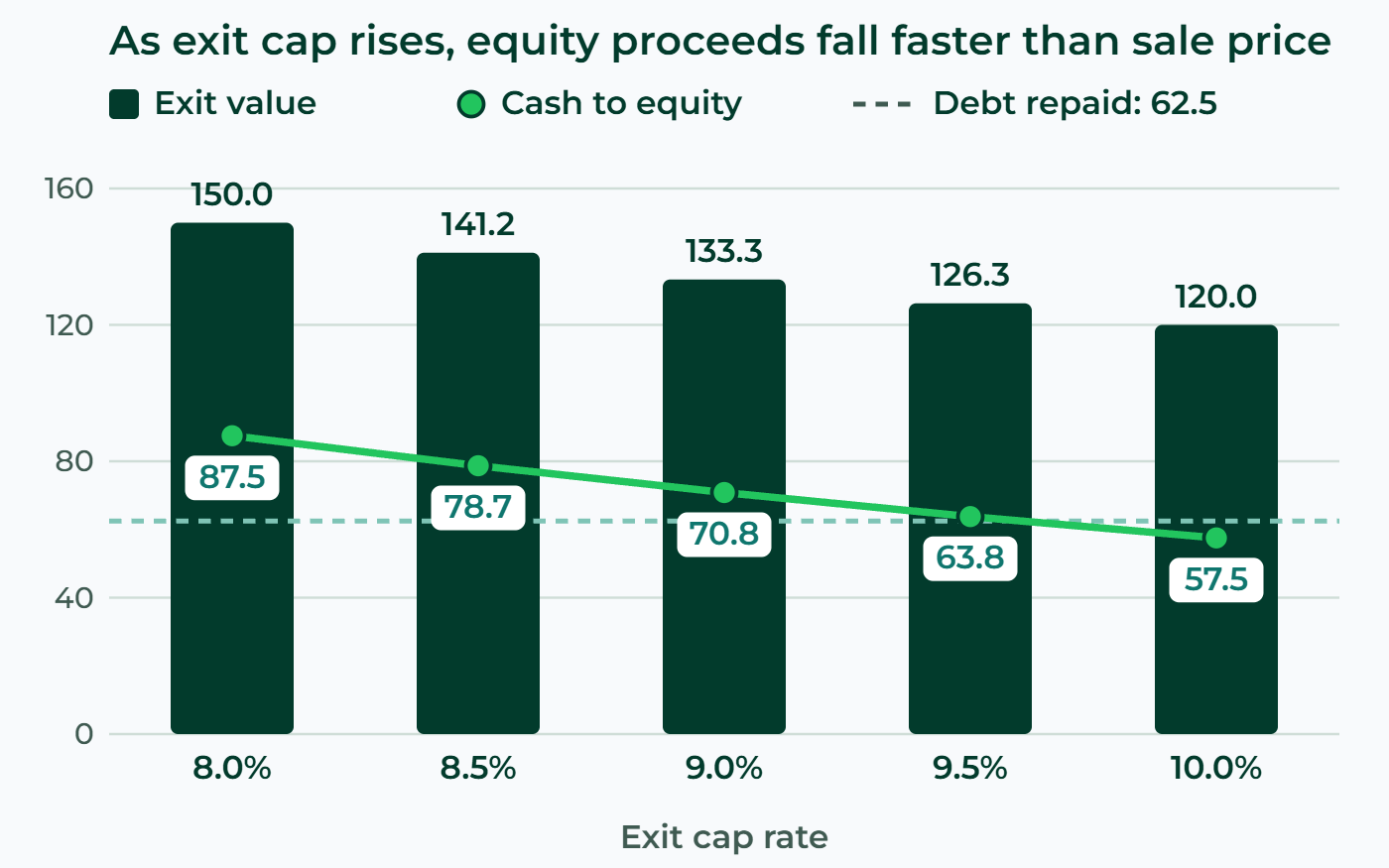
Two things stand out.
First, the sale price falls 20% when exit cap rises from 8% to 10%. Second, cash to equity falls from 87.5 to 57.5, about 34%, because the loan of 62.5 does not fall with the price. Leverage amplifies the error in exit cap. At 10%, investors do not even get their capital back (0.92x) on sale proceeds alone.
That is why I always put exit cap in the sensitivity table, often against rent growth or schedule delay, and never rely on a single value.
How to choose an exit cap rate
I follow three rules.
Do not go below the going-in cap without a clear reason. An asset a few years older usually has shorter remaining leases, and forecasts further out are always less certain. If you assume a lower exit cap than the purchase cap, you are assuming a better market or a better asset, and you need a reason, tested with a sensitivity table. In the US, many educational sources describe the habit of adding a cushion, often said to be 25 to 75 basis points over the going-in cap. (This is a foreign practice, not Vietnam data.)
Base it on comparable transactions, not on feel. Use recent sales of the same asset type in the same submarket. As with price and absorption assumptions, an in-house approach works at the preliminary stage for a quick view. Before committing significant capital, cross-check against advisers with larger databases, such as Savills, CBRE or JLL.
Always run a worse exit cap case. Add a scenario with a higher exit cap than your base case and see what IRR and multiple remain. If the deal only works with a low exit cap, you know where the biggest risk sits.
Where exit cap rate misleads
Three places.
It is one number hiding many assumptions. An 8% exit cap quietly says the market is still healthy, the asset is still attractive and buyers can still borrow. All three can be wrong at once.
Exit-year NOI is also an assumption. In the example NOI grows from 10 to 12. If it only reaches 11 and exit cap is 9%, the price is about 122. Two mildly wrong assumptions add up to a large error.
A model can look good because of a low exit cap. A high IRR is sometimes only the result of a too-low exit cap. I wrote about how assumptions inflate IRR in Equity IRR Explained.
Cap rate vs. yield on cost
The two are often confused. Cap rate uses the market value of the asset. Yield on cost uses the total cost you spent to create it. When yield on cost sits above the market cap rate, the project creates value over its development cost. Developers watch both.
A quick check
- Is your exit cap below the going-in cap? If so, what is the reason?
- Which year’s NOI is the exit value based on?
- Does the sensitivity table cover a range of at least a few points?
- What IRR and multiple remain when exit cap is one point worse?
- Does the loan make equity proceeds far more sensitive than the sale price?
Frequently asked questions
Should exit cap be higher or lower than the going-in cap?
Usually equal or higher, because the asset ages and forecasts further out are less certain. Lower means you assume a better market or asset, and needs testing with a downside case.
What is a cap rate, and what level is good?
Cap rate is NOI divided by asset value. There is no universally good level. It depends on asset type, location and strategy, and only means something against comparable transactions of the same type in the same area.
How is exit cap different from going-in cap?
The going-in cap is the result of a real transaction. The exit cap is an assumption about a future one.
Why use the NOI of the year after the sale?
The buyer prices on the income they are about to receive, so the model uses the NOI of the year following the sale.
Does cap rate account for the loan?
No. Cap rate describes the asset, not the capital structure. But the loan makes equity proceeds far more sensitive to exit cap, as the example shows.
To see where exit cap sits in a model, read Real Estate Financial Model Structure.
References
Next step
If you have a deal and need an exit assumption a lender or an LP will accept, see how CREFIC approaches valuation and investment models, or send the details through the consultation form.
Where did the exit cap in the last model you reviewed come from?
Have a deal to test?
Send the basics and we will tell you what a lender or investor would ask next.
Request a consultation