
The residual land value method values land as what remains of development revenue after subtracting all development costs, which already include the investor’s profit. Each year’s cash flows are discounted to present value.
This article is written from an investor and modeler’s perspective. It is not legal advice. Provisions are cited so you can look them up. For a real project, ask a lawyer about the specific point.
- Residual land value is development revenue minus development cost (which already includes profit), in present value.
- It can be solved directly: V = PV(revenue) / (1 + p) − PV(cost), with no circular reference in Excel.
- It is a remainder, so it amplifies error: in the example, revenue 10% lower cuts land value by 32.3%.
For a large project without enough comparable transactions, it is often the method left for setting a specific land price in Vietnam. A modeler should understand it thoroughly, because it is a financial model in miniature.
This article covers the principle and the arithmetic. Legal references are given with article numbers so you can look them up. The content below follows the consolidated text of Decree 71/2024/NĐ-CP, which merges the amendments of Decree 151/2025/NĐ-CP and Decree 226/2025/NĐ-CP (effective 15 August 2025). Before applying it to a real project, check whether any later document amends it. The English is my own rendering and is unofficial. The Vietnamese original prevails.
The residual land value method formula in Decree 71/2024
Article 6 of Decree 71/2024/NĐ-CP sets the value of the land use right of the plot being valued as:
Land price = Land use right value / Plot area
Total development revenue and total development cost are both present-value sums by year. Revenue in year i is TR(i), cost in year i is C(i), and each is divided by (1 + r) to the power i. Here r is the discount rate, taken from the average medium-term (1 to 3 year) VND lending rate for real estate investment projects at state-owned commercial banks, for the year ending in the most recent quarter with data before the valuation date.
The part people misread: profit sits inside cost
Total development cost includes interest and the investor’s profit. The decree calculates this as a percentage multiplied by the sum of three things: construction investment cost, business cost, and the land use right value of the very plot being valued.
Land value therefore appears on both sides, so the formula looks circular. In practice you do not need a circular reference in Excel. Let V be the land use right value, DT the present value of revenue, CP the present value of construction and business costs (before profit), and p the profit rate. From the formula above:
V = DT − CP − p × (CP + V)
Solving:
V = DT / (1 + p) − CP
This is my own algebraic rearrangement of the decree’s formula, not a formula written in the decree. The logic: the investor needs revenue equal to (1 + p) times the capital put in, which is cost plus land. So you divide revenue by (1 + p) to take profit out first, then subtract cost. What remains is land value.
The steps
The steps below follow the sequence in Article 6:
- Survey and collect information. On the plot, the land use plan, and the detailed construction plan or master plan already appraised and approved by the competent authority, to establish the highest and best use.
- Estimate revenue. Sale price, rental rate, price movement, sales period and start date, sales rate, occupancy rate. Prices are estimated by the comparison method, as for a plot already developed under an approved plan. Price movement follows data from the statistics office or the real estate market authority. If none exists, the transfer price movement uses the average consumer price index for housing, electricity, water and construction materials over the previous three years. For rents, the movement shown in the lease contracts can be used, or the same index. The valuation organisation proposes the choice of movement for the land price appraisal council to review and decide.
- Estimate development cost. Construction investment cost covers construction of the works (with an allowance for price escalation), temporary and auxiliary works, equipment, project management, consulting, site levelling, unexploded ordnance clearance, geological survey, construction insurance during the build, and other reasonable and valid costs. Business cost covers marketing, advertising, brand development, sales, sales discount support and operating management, set as a percentage of revenue. If revenue was estimated net of these costs (because of how the comparable plots were chosen), they are not counted again. Then add interest and profit. Compensation, support and resettlement costs under an approved plan are not part of total development cost. For plot-subdivision and land-sale projects, housing construction cost is not counted.
- Estimate total construction investment cost in this order of priority. First, a construction estimate appraised by the construction specialist agency and approved by the investor. Second, an estimate based on government-issued norms and unit prices that has been independently appraised or verified by a consultant. Third, the construction investment cost rate published by the Ministry of Construction. The estimate may be fixed as late as the first meeting of the specific land price appraisal council. If none of these exists, collect typical actual costs of the three nearest projects with the same main land use purpose.
- Discount to present value at rate r. Revenue runs over n sales years; cost runs over m years of construction and costs incurred.
- Calculate land use right value and land price with the two formulas above.
- One allocation decision with several types of area. If the decision covers land allocated with a land use fee, land leased with a one-time payment, land leased with annual payment or land allocated without a fee, the price is determined separately for the fee-paying allocated part and the one-time-lease part, and technical infrastructure cost is allocated by the area of those two parts.
- Land allocated under several decisions. If each decision has enough information to estimate revenue and cost, calculate by decision. If revenue cannot be estimated, or estimated cost exceeds estimated revenue for that area, calculate for the whole project under the approved detailed plan or master plan.
Who decides which number?
This is the big difference from an ordinary investment model. Many inputs are not the developer’s to choose.
Sales rate, occupancy rate, business cost, interest and profit rates are set by the provincial People’s Committee by project group, to apply no later than 1 January 2025, and the province may adjust them to local conditions. Where the province has not set them, the decree allows the use of actual data from the three nearest projects with the same main land use purpose, or lets the valuation organisation propose values in the explanatory report on the land price plan, for the land price appraisal council to review and decide. Sales and construction schedules are based first on the investment policy or the tender documents.
Because every province has its own rules and they change with each document, this article quotes no specific rates for any province. What a developer can prepare is its comparable evidence on sale prices and rents.
Residual method or K coefficient?
There are two main routes to the land price used for the land use fee.
Land price list multiplied by an adjustment coefficient (the K coefficient). Under Resolution 254/2025/QH15, Article 8, the provincial People’s Committee issues the land price adjustment coefficient, applicable from 1 January each year, and may amend it during the year or for specific areas or locations. The resolution took effect on 1 January 2026 (Article 13). The Government sets the details, and Decree 49/2026 explains how K is built.
Specific land valuation. Within it, development projects typically use the residual method.
The two routes are not fully separate. Under Decree 49/2026, when the market-movement coefficient is built, market land price is calculated from sample plots that were transferred, won at auction or priced by a competent authority, plus land prices from the income or residual method where there are not enough comparables. In other words, part of K derives from valuation results, including residual ones.
The decree names two cases where the land price list does not apply (Decree 49/2026, Article 5). One is allocation or lease of land for a sea-reclamation project or a project with a reclamation component. The other is a project with mixed purposes under construction planning, where the provincial People’s Committee considers and decides on determining a specific land price. The decree does not define mixed purpose, so whether an apartment project with a retail podium falls into this group has to be asked of the competent local authority.
Article 158 of the 2024 Land Law sets the conditions for each method. The comparison method needs at least three plots with the same land use purpose and similar factors affecting price. The income method is for agricultural land or non-residential non-agricultural land, where comparison is not possible but income and costs from the land use can be determined. The residual method is for a plot or site used for an investment project, where neither of those two methods is available but total development revenue and total development cost can be estimated. In other words, the residual method sits at the end of a chain of exclusions, and the land for a large project often has only this route left because there are no three comparable plots and no income to capitalise yet.
The developer does not choose the method. Under clause 9 of Article 158, the valuation organisation proposes the method and the specific land price appraisal council decides the choice. The developer proposes and argues the case.
Why a modeler needs this
Residual value is highly sensitive to sale price, construction cost and discount rate. Change the expected sale price and land value moves with it. The same lesson applies to exit cap in Exit Cap Rate Explained.
It tells you the maximum price to pay. When land is bought at auction, the amount payable is the winning bid. The key calculation then is to use your own residual analysis to find the highest price you should pay, and compare it with the starting price to see your room.
Advanced compensation. Decree 71 excludes compensation, support and resettlement costs from development cost, and refers to clause 2 of Article 94 of the Land Law for repaying amounts the developer voluntarily advanced. Under that article, where the State allocates land with a land use fee or leases land, an advance made under the approved plan is repaid by deducting it from the land use fee or rent payable, and the deduction cannot exceed the amount payable. Any balance counts as project investment cost. For a project allocated land without a fee, or exempted in full, the advance counts as investment cost. The consequence for the model: it changes the cash actually paid, not the total land cost.
An example: a hypothetical project
Suppose the present value of development revenue is VND 1,000 billion, the present value of construction and business costs is 600, and the profit rate is 15%. (Illustration only. The real profit rate is set by the province or decided by the council; 15% here only illustrates the arithmetic.)
Land value by the formula V = DT / (1 + p) − CP is 1,000 / 1.15 − 600 = 269.6 billion. Check: profit equals 15% times (600 + 269.6) = 130.4 billion, and 1,000 − 600 − 269.6 also equals 130.4. The two sides match.
Now change one assumption at a time:
| Scenario | DT | CP | p | Land value (billion) | vs. baseline |
|---|---|---|---|---|---|
| Baseline | 1,000 | 600 | 15% | 269.6 | 0% |
| Revenue 10% lower | 900 | 600 | 15% | 182.6 | −32.3% |
| Cost 10% higher | 1,000 | 660 | 15% | 209.6 | −22.3% |
| Profit rate 20% | 1,000 | 600 | 20% | 233.3 | −13.4% |
| Revenue 10% lower and cost 10% higher | 900 | 660 | 15% | 122.6 | −54.5% |
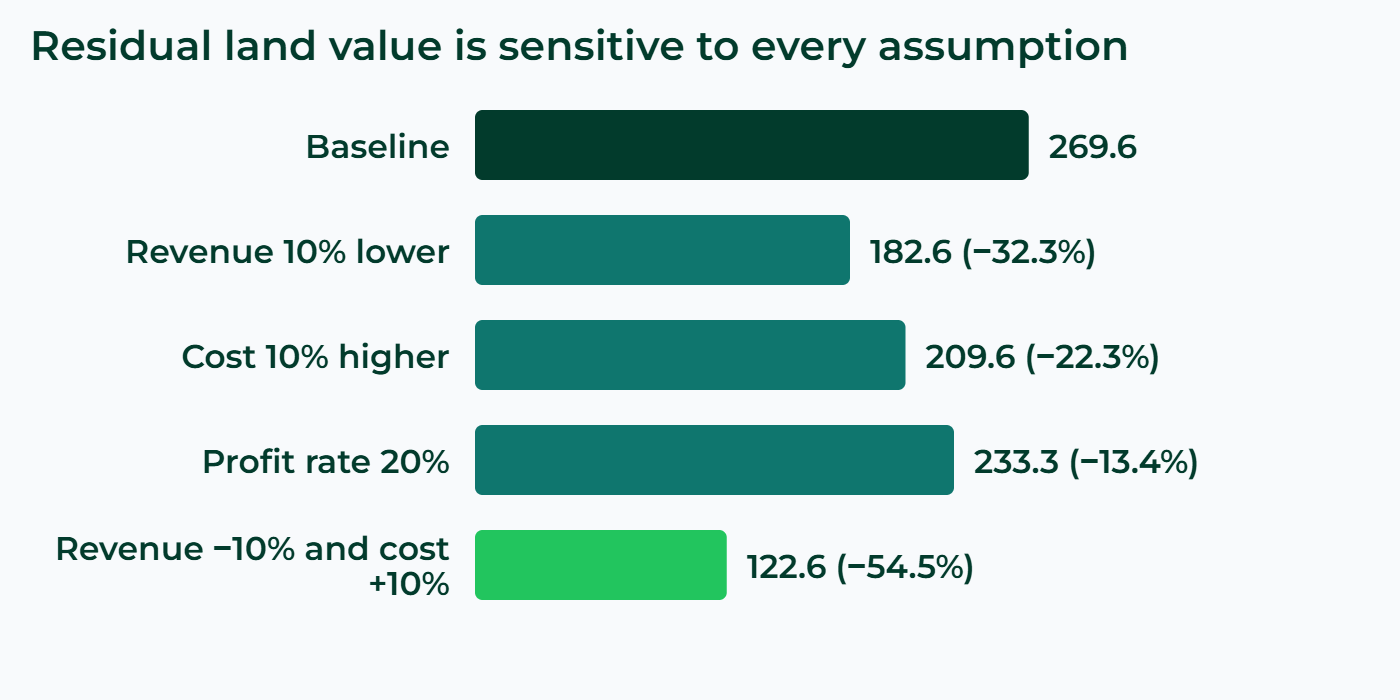
Revenue 10% lower cuts land value by more than 32%. Revenue and cost both off by 10% in the bad direction cuts land value by more than half. That is the nature of the residual method: land value is what remains, so every error in revenue and cost lands on it.
Where the residual method misleads
A remainder amplifies error. A 10% error in revenue becomes an error of over 30% in land value.
Many inputs are not yours to choose. Sales rate, business cost and profit are set by the province or taken from the nearest projects. However good your model, it has to follow those rates when the land use fee is calculated.
Using one province’s inputs for another. Each province has its own rules, and they change with each document.
A quick check
- Which comparable projects does your model take sale prices from?
- Have you run slower sales and later construction to see how far land value moves?
- Is your project on the price-list-times-K route or specific valuation?
- Are compensation, support and resettlement costs excluded from development cost?
- Do the sales rate, business cost and profit in your model follow the rules of the province where the land sits?
To see the legal chain that land valuation sits in, read Vietnam Real Estate Approvals for Foreign Investors. To see why schedule affects returns, read Equity IRR Explained.
Frequently asked questions
What is the residual land value method?
A way to value land as total development revenue minus total development cost, both in present value, where cost includes a reasonable profit for the investor.
When is it used?
Where the comparison and income methods cannot be applied but development revenue and cost can be estimated (Article 158 of the Land Law).
What is the K coefficient?
A land price adjustment coefficient issued by the provincial People’s Committee, applied from 1 January each year and multiplied by the price in the land price list (Resolution 254/2025/QH15, Article 8).
Who sets the sales rate, business cost and profit rate?
The provincial People’s Committee, by project group. Where it has not, the data of the three nearest projects is used, or the valuation organisation proposes values for the council to decide.
Does compensation count in development cost?
No. Compensation, support and resettlement costs under the approved plan are not part of total development cost.
Is this legal advice?
No. It is written from an investor and modeler’s perspective.
References
Next step
If you are weighing a land acquisition in Vietnam and need the land cost built into a model a lender or partner will trust, see how CREFIC supports offshore investors on the Vietnam real estate advisory page, or send the project details through the consultation form.
Which route is the land price on your project being set by?
Have a deal to test?
Send the basics and we will tell you what a lender or investor would ask next.
Request a consultation