Vietnam real estate approvals for foreign investors usually follow one of two routes: lease land directly from the State, or form a joint venture (JV) with a Vietnamese partner that already holds the land. The two routes have different step counts. Fewer steps does not mean easier.
This article is written from an investor and modeler’s perspective. It is not legal advice. Provisions are cited so you can look them up. For a real project, ask a lawyer about the specific point.
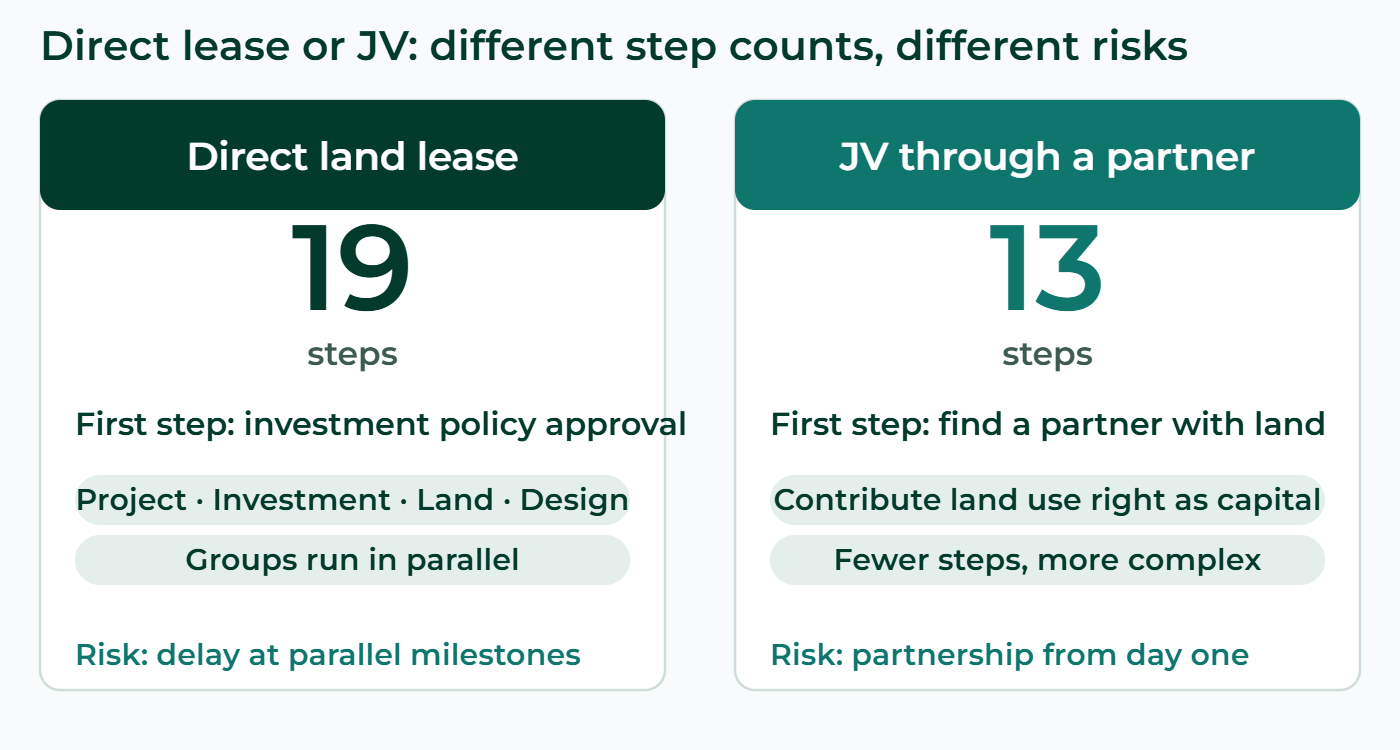
- Two routes into a project: direct land lease from the State (19 steps) or a JV through a partner (13 steps), per flowcharts compiled by CREFIC.
- Fewer steps is not easier: a JV spreads legal risk but partnership risk appears from day one.
- Each legal milestone is time capital sits idle: in the example, a six-month delay cuts IRR by nearly four points.
This article summarises both routes from the flowcharts I put together. Every legal point must be checked against current legislation before you rely on it for a real project.
Route 1: direct land lease from the State
This is not one step. It is 19, from in-principle approval to handover to buyers.
The steps fall into four main groups:
- Legal for Project
- Legal for Investment
- Legal for Land
- Legal for Design
These run in parallel at some stages and are not strictly sequential. A delay in one group can therefore hold up another.
For example, before an investor receives an investment registration certificate, it has typically passed through these milestones:
- Investment policy approval
- Project site proposal
- Architectural planning agreement
- Appraisal and approval of the feasibility study
- Investment site agreement
- Signing of the land lease contract
- 1/500 master plan
Each milestone involves a specific state authority, a set of documents to submit, a defined outcome and an expected timeline. The exact order and official names need to be confirmed against current rules.
Route 2: JV through the partner’s land use rights
Instead of leasing directly from the State, the JV route works through land use rights (LUR) the Vietnamese partner already holds. There are 13 main steps, from site search to handover.
The biggest difference sits at the start. You do not begin by seeking investment policy approval. You begin by finding a partner with land, and negotiating the terms of contributing that land use right as capital.
The result is that legal risk is spread out, but partnership risk appears from day one. That is what the JV agreement has to address before any legal step starts.
Vietnam real estate approvals: the two routes compared
| Direct land lease | JV through a partner | |
|---|---|---|
| Main steps | 19 | 13 |
| First step | Investment policy approval | Find a partner and negotiate land-use-right contribution |
| Main risk | Delay across parallel approval milestones | Partnership risk from day one |
| Is fewer steps easier? | Not applicable | No. Fewer steps, but more complex |
What this article does not cover
- Project transfer procedure. Acquiring an existing project (a full or partial project transfer, or buying the shares of a project company) is a third route with its own rules. This article does not explain it. I will write it separately after checking the source texts.
- Cost and timing. Each milestone has an expected timeline, but real timing depends on the locality and the file. No specific number of months is given here.
- Land use fee obligations. Land-related financial obligations feed directly into the model. For how they are calculated, see the article on the residual method and the K coefficient.
How much does legal delay cut IRR?
Each legal step is a stretch of time during which capital sits idle. Reuse the hypothetical project from Equity IRR Explained: equity of 100 invested over the first two years, proceeds of 200 in years 3 and 4.
| Scenario | IRR | Multiple |
|---|---|---|
| Schedule as planned | 25.1% | 2.00x |
| Six months’ delay at the approval milestones, revenue arriving that much later | 21.2% | 2.00x |
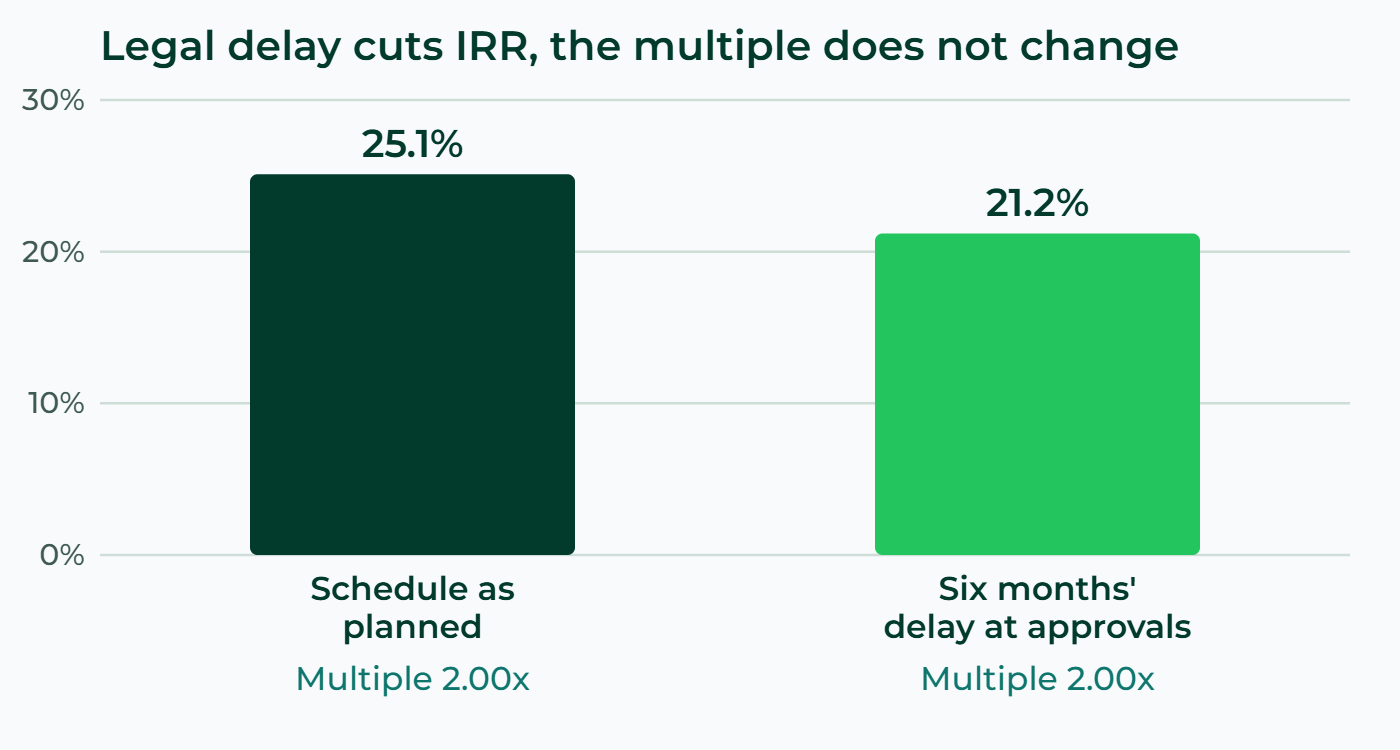
A six-month delay does not change the multiple, but IRR falls by nearly four percentage points. On the direct lease route, with several milestones running in parallel, one late milestone can pull the whole chain. On the JV route, the schedule also depends on the partnership.
Where the approval process misleads a model
A smooth legal schedule. The model assumes every milestone lands on time. No delayed site clearance, planning agreement or completion sign-off.
Counting steps, not risk. JV has fewer steps but is not easier, because partnership risk appears from day one.
Treating the figures here as standard. The step counts (19 and 13) come from the flowcharts I put together. Every project and every locality differs.
Why modelers need to understand this
Every legal step is a stretch of time during which capital sits idle. A model that assumes a smooth schedule without legal delay will inflate IRR. This is one of the five places IRR gets inflated that I described in Equity IRR Explained. A good model puts the legal timeline in the Inputs tab and includes a delay case at the key milestones.
The feasibility study is also a milestone that must be appraised and approved in this chain. See Real Estate Feasibility Study.
Frequently asked questions
What do Vietnam real estate approvals involve for a foreign investor?
Two routes: a direct land lease from the State, or a JV through a Vietnamese partner that already holds land.
How many steps is a direct land lease from the State?
According to the flowchart I put together, 19, from in-principle approval to handover to buyers, grouped into four: project, investment, land and design.
How many steps is a JV?
13 main steps, working through land use rights the Vietnamese partner already holds.
Is a JV easier than a direct lease?
Fewer steps, but more complex. Legal risk is spread out, while partnership risk appears from day one.
What is the first step on each route?
The direct lease starts with investment policy approval. The JV starts with finding a partner that holds land and negotiating the terms of contributing that land use right as capital.
Is this legal advice?
No. It is written from an investor and modeler’s perspective.
References
- Full text of the Land Law on the Government portal (Vietnamese)
- Decree 217/2026/NĐ-CP on the Government document portal
Next step
If you are weighing a lease against a JV for a project in Vietnam, see how CREFIC supports offshore investors from deal sourcing to closing on the Vietnam real estate advisory page, or send the project details through the consultation form.
Which route are you considering, and which risk worries you most?
Have a deal to test?
Send the basics and we will tell you what a lender or investor would ask next.
Request a consultation