A real estate feasibility study answers one question: should this project go ahead?
It answers it under current market conditions, with real costs and real risks, not the best-case scenario. Many sponsors treat a feasibility study as a document to attach to an approval or a loan request. I treat it as the tool that makes the decision.
- A feasibility study answers one question: should this project go ahead?
- A good one tests profitability under realistic conditions, names the biggest risk and gives a basis to decide.
- Complete is not good enough: in the example, two modest adjustments cut profit by 64%.
What a good real estate feasibility study does
A well-built study does three things.
It tests profitability under realistic market conditions. Sale prices, sales pace, construction cost and cost of capital each need a basis, and each needs to survive being questioned.
It names the biggest risk before you commit money. Late delivery, prices below expectation, rising costs. If you know which one breaks the project first, you can plan for it.
It gives you a basis to decide. Proceed, stop or adjust. Those three options only mean something when the numbers behind them are credible enough to lean on.
Why sponsors skip it
Because they think they already know the answer.
They like the site. They can picture the product. They already have a profit figure in their head.
A feeling is not an analysis. I have seen projects that looked very attractive at first glance. Once real costs and a realistic absorption rate went into the model, the profit nearly disappeared. The project was not necessarily bad. The starting assumptions were too optimistic.
A proper study shows you that before you sign. After you sign, you can only live with it.
Why two studies of the same project look different
If you have read feasibility models from several firms, you will have noticed how much they differ. The revenue build is different, the cost lines are different, and the level of detail is different. For a serviced apartment project, one model puts operating expenses on a single line as a percentage of revenue. Another breaks them out: management, insurance, maintenance, utilities, marketing, commissions.
In my experience building models for sponsors in different markets, this usually comes down to one thing. Each audience needs the model to show different information. No version is more correct than another in form.
What matters more than form is three things:
- Knowing what each revenue and cost line represents in real operations.
- Knowing the strategy behind the asset class, because each one creates value differently.
- Knowing how much detail the decision-maker needs to see.
With those in place, Excel is just the tool that delivers it.
An example: where the profit disappears
Take a hypothetical project. The initial report shows revenue of 1,000, cost of 800 and profit of 200 (in VND billions). Apply two realistic adjustments: slower sales, so the present value of revenue is 8% lower, and construction cost plus cost of capital 6% higher.
| Initial | After adjustment | |
|---|---|---|
| Revenue | 1,000 | 920 |
| Cost | 800 | 848 |
| Profit | 200 | 72 |
| Margin on revenue | 20% | about 7.8% |
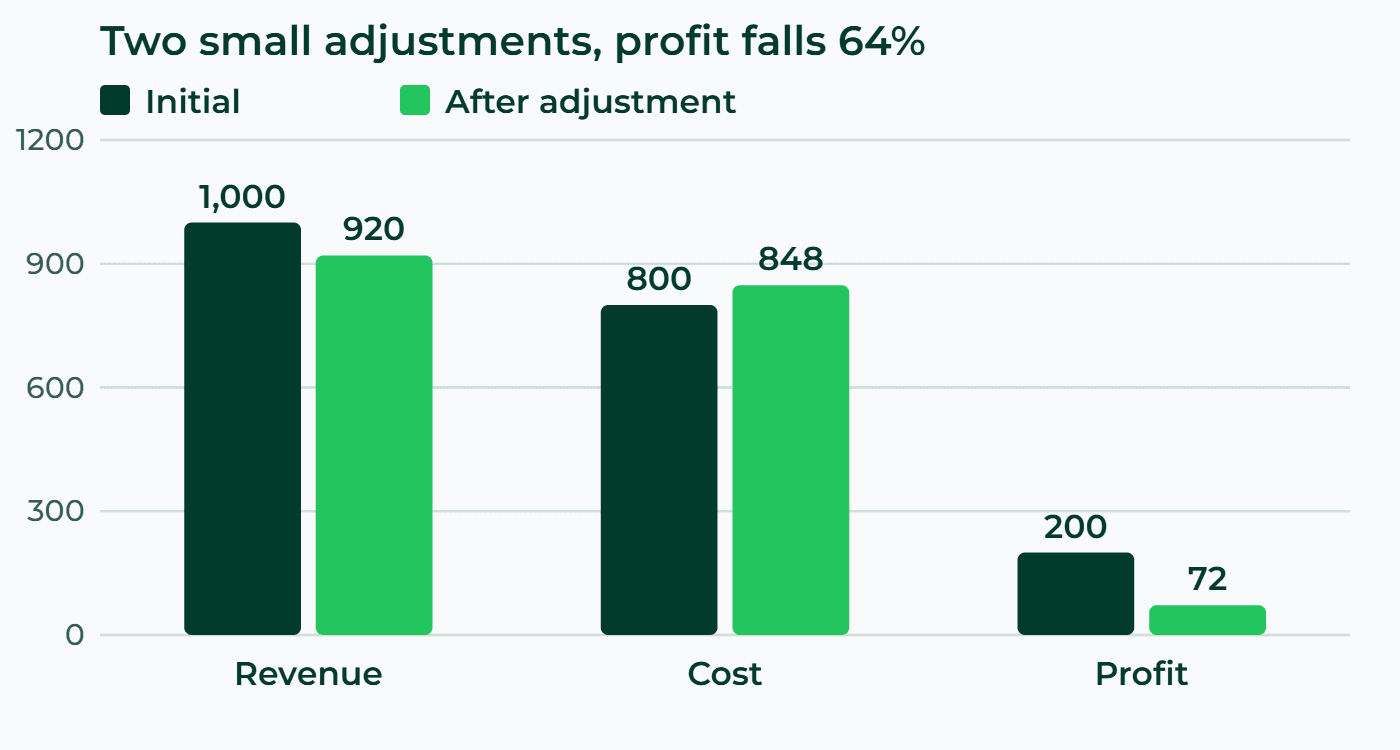
Two modest adjustments cut profit by 64%. The project did not get worse. The starting assumptions had simply not been tested. That is what I want a study to do: show you before you sign.
Where a feasibility study misleads
It only has the pretty case. The base case is already the best case, and the downside only trims the price a little.
It describes more than it analyses. The first page covers location, size and amenities. The question “should we proceed?” is never answered with a number or a specific condition.
It puts everything on one profit figure. A single metric gives confidence, not clarity. I covered this in Equity IRR Explained.
Five checks before you trust yours
- Where do the price and sales-pace assumptions come from, in that submarket and for that product?
- Does the downside case combine slower sales, later delivery and higher costs, or does it only trim the price?
- Is the cost of capital, including equity, in the model?
- Is the biggest risk written as a specific line in the analysis, or does it only appear in the general description?
- If the decision-maker asks “where does this break?”, which cell can you point to?
If you cannot answer one of these, the study is not finished.
For construction investment projects in Vietnam, the feasibility study report is also a legal document, and its contents are set by Decree 217/2026/NĐ-CP from 1 July 2026. See Vietnam Feasibility Study Report: Decree 217/2026 for what it requires.
To see how a headline return gets inflated inside a model, read Equity IRR Explained.
Frequently asked questions
What is a real estate feasibility study?
An analysis that answers one question: should this project go ahead, under current market conditions, with real costs and real risks?
How is it different from an economic and technical report?
Under Decree 217/2026/NĐ-CP, Article 27, small or technically simple projects only need an economic and technical report. One example is a project with total investment of no more than VND 40 billion, excluding compensation, site clearance and land use fees. See Vietnam Feasibility Study Report: Decree 217/2026. This article is written from an investor’s perspective, not as legal advice.
What does a good study do?
Three things: tests profitability under realistic market conditions, names the biggest risk before you commit money, and gives you a basis to proceed, stop or adjust.
Does it replace the financial model?
No. The study is the question and the reasoning. The financial model is the tool that answers the numerical part.
Why do studies from different firms look different?
Because each audience needs the model to show different information. A difference in form does not mean one is more correct.
References
Next step
If you have a project and need a feasibility model that a lender, a partner or an investment committee will take seriously, you can see how CREFIC builds them on the investment advisory page, request sample models to look at the structure, or send the deal details through the consultation form.
When did you last read a feasibility study that answered “should we proceed?” rather than just describing the project?
Have a deal to test?
Send the basics and we will tell you what a lender or investor would ask next.
Request a consultation