
Most problems in a real estate financial model structure are not math problems. They are navigation problems.
After building more than 120 underwriting models, I use the same architecture every time. The reason is not neatness. An LP opens your file and wants to stress-test one assumption, say exit cap or lease-up timing. If they cannot find it in 60 seconds, trust starts to erode. Not because you are wrong, but because they cannot tell whether you are right.
- Most model problems are navigation problems, not math problems.
- Four tab groups: Inputs, Dashboard, cash flow tabs, analysis tabs. Each tab does one job.
- Use XIRR for uneven cash flows, and link instead of retyping.
The four tab groups of a real estate financial model structure
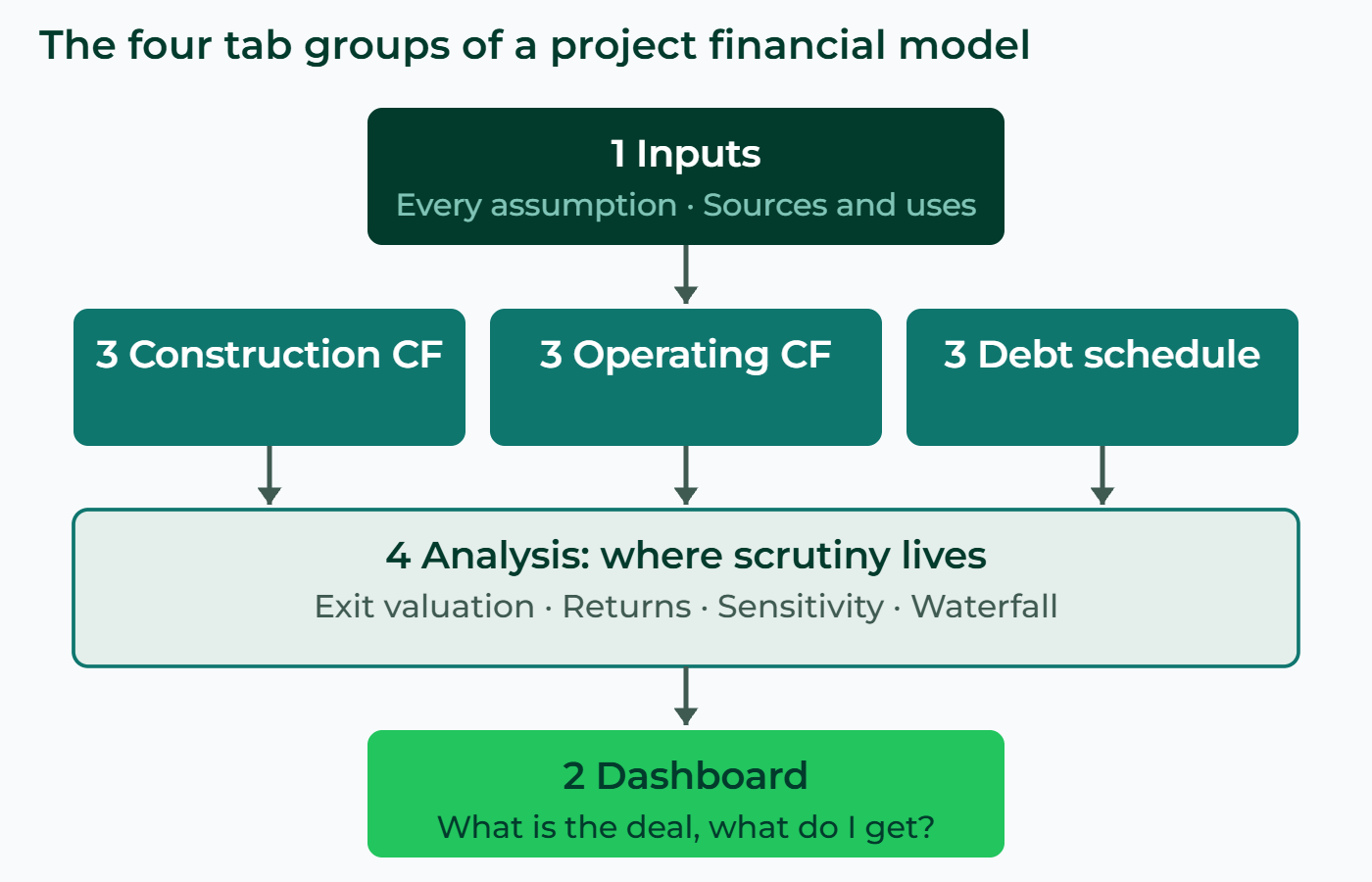
1. Inputs: the control center. Every hardcoded assumption lives here: acquisition price, growth rates, exit cap, vacancy or absorption, construction timeline, loan terms. One tab, one place. When an LP asks what happens if rent growth is 2% instead of 3%, you change one cell and the whole model updates. No broken links, no hardcode buried in row 847. I keep sources and uses on this tab too, because it anchors the capital story before anyone touches the cash flows.
2. Dashboard: the executive summary. It holds the property description (location, size, use, strategy), key return metrics, a high-level cash flow snapshot and the capital structure. It should read in two minutes. If it does not answer “what is the deal and what do I get?”, it is not doing its job.
3. Cash flow tabs: the engine. Split construction cash flow (monthly during development), operating cash flow and the debt schedule. Each tab does one job. Do not mix construction draws with operating NOI, and do not hide debt service in a blended schedule. Clean separation gives a clean audit trail.
4. Analysis tabs: where scrutiny lives. Exit valuation, the returns tab, sensitivity tables (exit cap against rent growth, schedule delay, cost overrun) and the equity waterfall with pref, catch-up and promote tiers. The waterfall matters most. If an LP cannot trace how their return is calculated, they assume something is wrong, even when nothing is.
What goes on the Returns tab
Many modelers calculate IRR at the bottom of the operating cash flow tab. That is fine. I split it out so that one click shows the returns without scrolling past 50 rows of cash flow.
My Returns tab has two parts. The levered part shows a monthly timeline, equity contributions (linked from the construction cash flow), net distributions to investors, net exit proceeds (linked from the exit valuation tab), net cash flow to investors, IRR, equity multiple and annual ROI. The unlevered part has the same layout but uses total project cost instead of equity.
Two mechanics matter:
Use XIRR, not IRR. XIRR uses actual dates. IRR assumes evenly spaced periods. Development cash flows are uneven (build, lease or sell, stabilise, exit), so XIRR gives the right answer.
Link, do not retype. Exit value links from the exit valuation tab. Equity contributions link from the construction cash flow. When exit cap or NOI changes, returns update on their own. Every number has one source.
A lighter version for screening: the BOTE model
Not every deal deserves a full build on day one. For screening I use a back-of-the-envelope model with two tabs, Inputs and Outputs. It takes 20 to 30 minutes per deal instead of two to three days. Inputs are property specs, sources and uses, revenue and OPEX as percentages, financing and exit cap. Outputs are annual cash flow, IRR, equity multiple, DSCR and a sensitivity grid.
You can use Goal Seek to find your maximum offer price: what does the price need to be to reach the target IRR? The full model is built only after the deal earns it.
What an investor asks and which tab answers it
One way to test a model’s structure is to take the questions investors actually ask and see where you can point within a few dozen seconds.
| Investor’s question | Tab that answers it |
|---|---|
| What is the deal and what do I get? | Dashboard |
| What if exit cap is 9% instead of 8%? | Inputs (change one cell), results on Returns and the sensitivity table |
| How much capital does the project need and what is it used for? | Sources and uses, on Inputs |
| What if the schedule slips six months? | Inputs, construction cash flow, sensitivity table |
| Can the loan be serviced? | Debt schedule and DSCR |
| How is my return calculated? | Waterfall |
If any row makes you scroll across several tabs, the structure has a problem.
Where a model misleads
Hidden hardcodes. An assumption sits in row 847 of a cash flow tab, and nobody sees it until it is wrong.
Construction and operating cash flows mixed. You can no longer trace what produces NOI.
A hand-typed dashboard. If the dashboard is not linked to its sources, it can look good and be wrong.
IRR on uneven cash flows. IRR assumes evenly spaced periods. Development cash flows are uneven, so you need XIRR.
A waterfall that cannot be traced. If investors cannot see how their return comes out, they assume something is wrong, even when nothing is.
A quick check before your next raise
- Can someone find every key assumption in under 60 seconds?
- Does the dashboard answer “what is the deal and what do I get?”
- Are construction and operating cash flows cleanly separated?
- Can the waterfall be traced without an explanation?
If all four are yes, you are close to an investor-ready model.
To see how the headline return in a model gets inflated, read Equity IRR Explained. To see what question a model should answer, read Real Estate Feasibility Study.
Frequently asked questions
What is a good real estate financial model structure?
Four tab groups, each doing one job: Inputs, Dashboard, cash flow tabs and analysis tabs.
How many tabs should a development financial model have?
There is no fixed number. What matters is that each tab does one job: Inputs, Dashboard, cash flow tabs, analysis tabs. A 14-tab model where nobody can find an assumption in 60 seconds is worse than a leaner one.
Why keep every assumption on one Inputs tab?
So that when an investor asks “what if rent growth is 2% instead of 3%?”, you change one cell and the whole model updates, with no broken links or hidden hardcodes.
When should I use XIRR instead of IRR?
When cash flows are uneven in time, as in a development (build, then sell or lease, then stabilise, then exit). XIRR uses actual dates; IRR assumes evenly spaced periods.
Do I need a waterfall tab?
When several investors hold different rights (pref, catch-up, promote), yes. It lets each party trace their own return.
When is a two-tab BOTE model enough?
At the deal-screening stage, taking 20 to 30 minutes a deal. The full model is built only after the deal earns it.
References
Next step
If you need a model that a lender or an LP will open and trust, see how CREFIC builds investment models, request sample models to look at the structure, or send the deal through the consultation form.
How long does it take you to find the most important assumption in a model someone else built?
Have a deal to test?
Send the basics and we will tell you what a lender or investor would ask next.
Request a consultation